DnXT eDMS — Compliant Document Management for Life Sciences
Compliant Document Management
Beyond the Submission.
DnXT eDMS manages controlled documents across 6 compliance categories and 39 subtypes — with 21 CFR Part 11 electronic signatures verified cryptographically, per-document audit trails, training management, and one-click inspection audit packs. A built-in labeling module adds CCDS comparison, per-market due dates and an artwork change-control gate. Enterprise document control without the enterprise implementation project.
Subtypes
Pack
US·EU·CA·JP
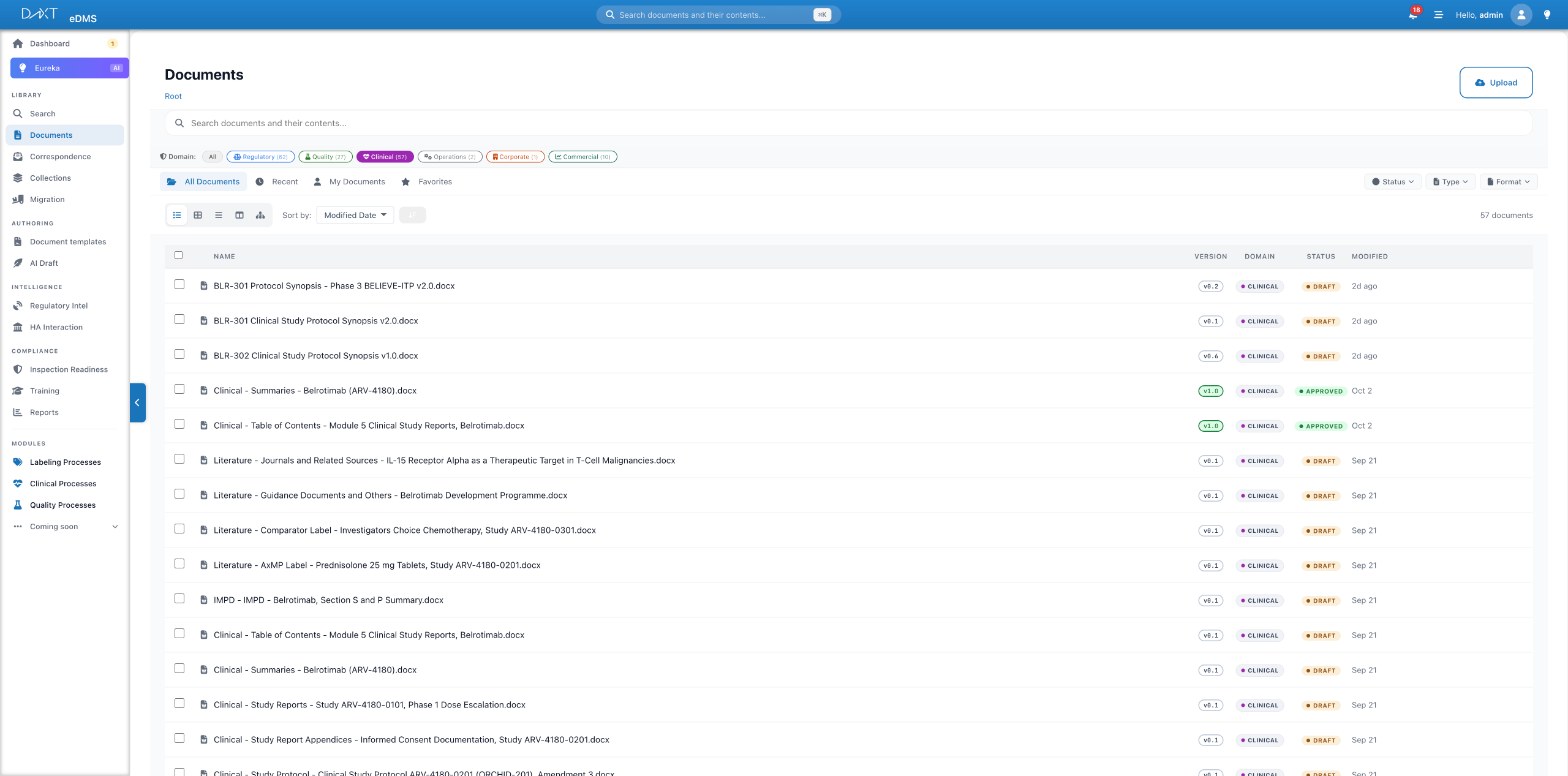
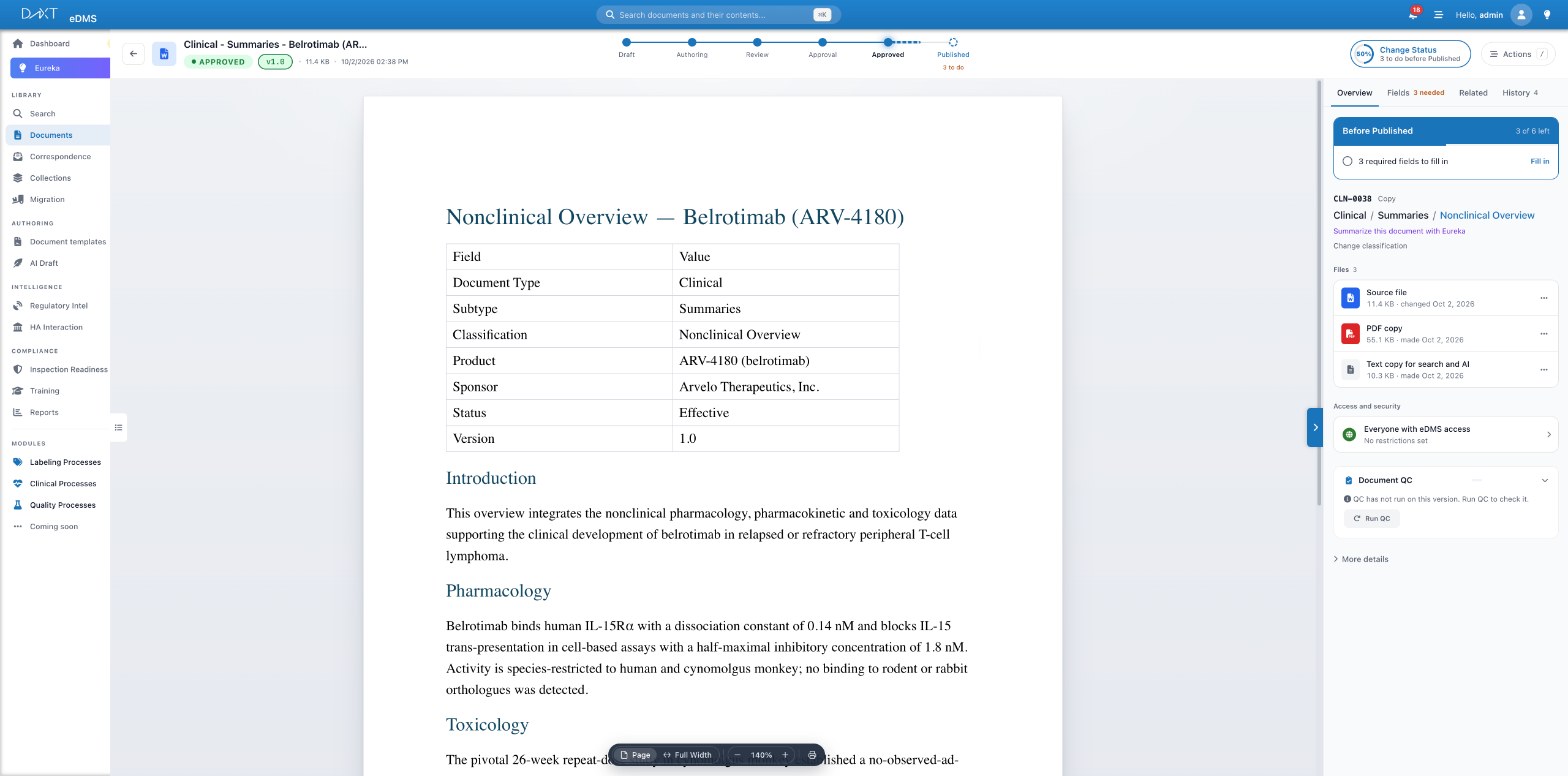
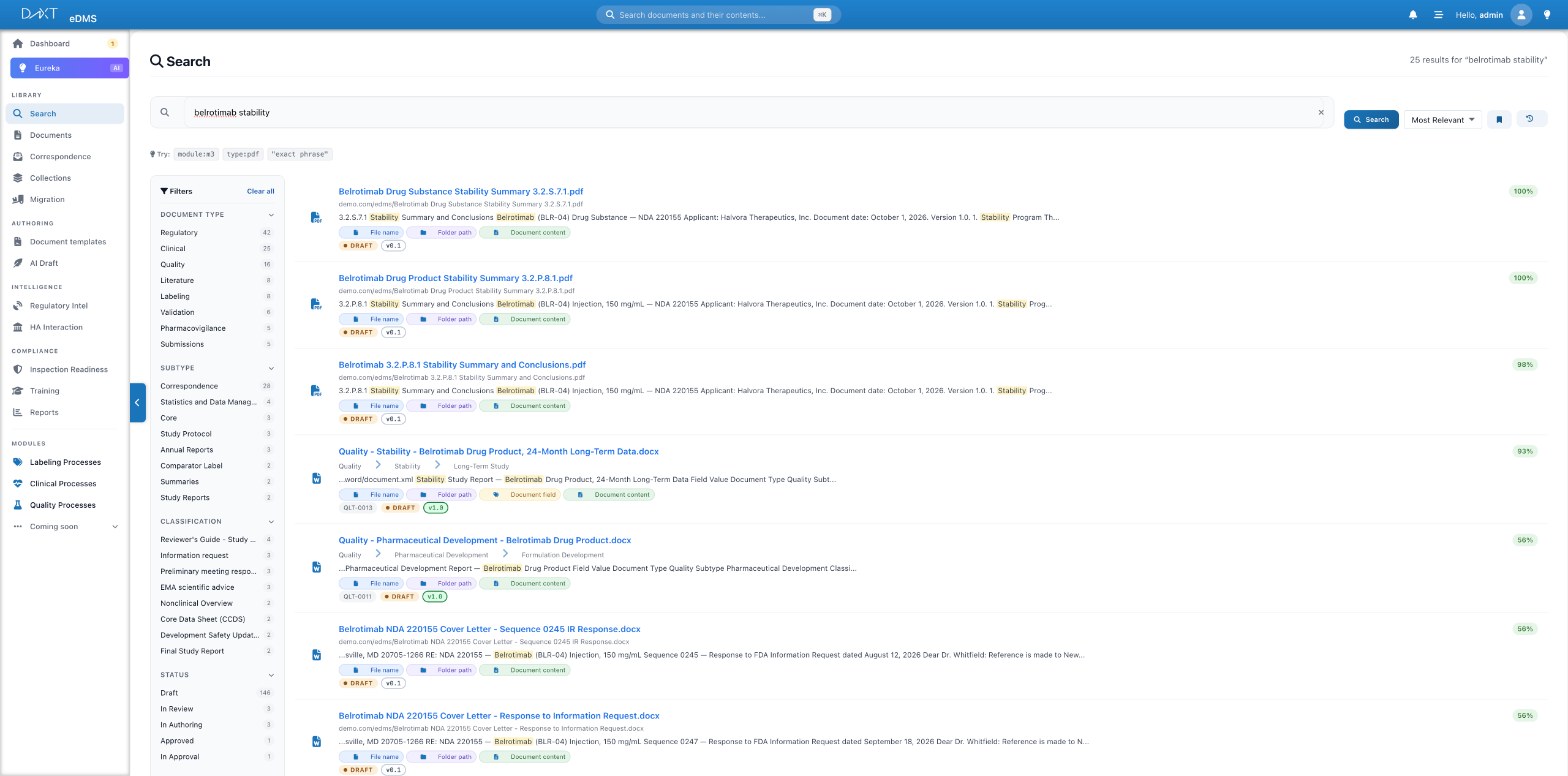
Real screens from DnXT eDMS
Captured from our demo workspace. Every name and number on screen is sample data.
Who This Is Built For
Document control touches everyone, but three roles carry the accountability. DnXT eDMS was designed around them.
Your SOPs live in SharePoint, your signatures live on scanned PDFs, and your training records live in a spreadsheet only one person understands. An inspection is survivable today because the company is small — but every new hire, product, and site multiplies the risk. You need real document control with Part 11 signatures before an inspector, not after one.
- Controlled lifecycle: draft → review → approval → effective, enforced by workflow
- Part 11 e-signatures with password re-authentication and SHA-256 verification
- Training assignments and acknowledgments tied to document effectiveness
- Inspection readiness score that tells you where you stand before the audit does
Regulatory has its documents, Quality has its documents, Clinical has its documents — and each department wants its own taxonomy, workflows, and reviewers. Forcing everything into one flat structure satisfies nobody; running three systems satisfies nobody either. You need one platform whose classification model actually matches how a life-sciences company organizes controlled content.
- Compliance domains: 6 categories and 39 subtypes spanning regulatory, quality, clinical, and corporate
- Per-domain workflows and reviewers without separate systems
- AI classification with an 18-rule deterministic fallback for consistent filing
- Bulk import from eCTD sequences with classification mapping built in
Enterprise document platforms are proven, but they are large programmes to configure, validate and change. For a company that needs compliant document control this quarter, the enterprise route's cost and timeline are themselves a compliance risk.
- Cloud-native, browser-only — no client installs, no infrastructure project
- Tenant-isolated multi-tenant architecture with per-tenant configuration
- Regional support for US, EU, CA, and JP document conventions
- Part of one platform with publishing and planning — not another integration to own
How It Works
From ingestion to inspection — what happens to a controlled document in DnXT eDMS.
Documents enter individually or via bulk import — including directly from eCTD sequences, with classification mapping from submission structure to document types. AI classification proposes the category and subtype from the 6-category, 39-subtype taxonomy, with an 18-rule deterministic engine as fallback, so filing stays consistent whether AI is enabled or not. A human confirms; the system records who.
Each document moves through a controlled lifecycle — draft, review, approval, effective, obsolete — driven by the platform's workflow engine. Reviewers and approvers are assigned per domain, transitions require the right role, and every state change lands in the document's audit trail. Renditions are generated for consistent viewing regardless of source format.
Approval steps capture 21 CFR Part 11 electronic signatures: the signer re-authenticates with their password at the moment of signing, the signature records identity, timestamp, and meaning (authorship, review, approval), and the record is hashed with SHA-256. Signatures can be voided with reason, and the manifestation appears on the document itself.
When a controlled document becomes effective, training management takes over: groups are assigned, acknowledgments are collected, exemptions are recorded with rationale, and the training matrix updates in real time. The compliance dashboard shows exactly who has read what — the question every inspector asks about SOPs, answered before it's asked.
Every action on every document — creation, edits, state changes, signatures, permission changes, views where configured — is recorded in an immutable audit trail. There is no "enable auditing" checkbox to forget, because auditing is not optional in the architecture. The audit trail is the raw material for everything in step 6.
The inspection readiness module continuously scores your document-control posture — signature completeness, training coverage, overdue reviews — so audit preparation is a standing state rather than a fire drill. One click generates an audit pack for a scope of documents, and mock inspection mode lets QA rehearse the real thing against real records.
Six eDMS Capabilities That Stand Up in an Inspection
Document management is easy to demo and hard to defend. These are the capabilities inspectors actually probe.
Compliance Domains
A classification model built for life sciences: 6 compliance categories spanning 39 document subtypes across regulatory, quality, clinical, and corporate content. Each domain carries its own workflows and reviewer assignments, so Quality's SOP approval chain and Regulatory's submission-document flow coexist on one platform without either team bending to the other's process.
Part 11 E-Signatures
Signatures capture identity, timestamp, and meaning; signers re-authenticate at the moment of signing; and every signature is SHA-256 hashed with the content it signs. Initiate, sign, void-with-reason, and manifestation on the document are all first-class operations — not a plugin bolted onto a file share.
Training Management
Training groups, assignments, acknowledgments, and exemptions are managed against effective documents, with a live training matrix and compliance dashboard. Because training is wired to the document lifecycle, a new SOP version automatically raises the question "who needs retraining?" — and answers it.
Per-Document Audit Trail
Every document carries its complete history — who created it, who changed what, who signed, who was granted access — in an immutable audit trail that is always on. This is the evidence base for inspections, deviations, and internal investigations alike, consistent with the platform-wide audit architecture.
Inspection Readiness
A continuous readiness score across signature completeness, training coverage, and review currency; one-click audit-pack generation for any document scope; and a mock-inspection mode for rehearsing with real records. The goal is simple: the day the inspector arrives should feel like every other day.
eCTD-Aware Bulk Import
Import documents in bulk directly from eCTD sequences, with classification mapping that understands submission structure — so the dossier you filed and the controlled documents behind it stay connected. AI classification with an 18-rule deterministic fallback keeps high-volume intake consistent, and regional conventions for US, EU, CA, and JP are supported out of the box.
The Labeling Module
Labeling is document control with a deadline attached. It runs inside DnXT eDMS — the same controlled documents, versions, signatures and audit trail — with the machinery the rest of document management doesn't need.
CCDS Comparison & Deviation Control
Local labels are compared against the Company Core Data Sheet structurally rather than word by word, including tables, and graded across four verdict tiers so formatting-only differences don't generate work. Every remaining difference must be adjudicated with a recorded decision before the comparison report can be produced.
Per-Market Submission Clock
Configurable change classes drive a due date for every market, with the binding constraint named, basis-label dependency modelled as a blocking state rather than a guessed date, health-authority overrides, and deferrals recorded with rationale and approver.
Artwork Change-Control Gate
Artwork cannot be approved until its CMC change control is resolved and confirmed approved for implementation. Missing, unapproved and closed change controls all block, signature authority scales with the magnitude of the change, and absent information never opens the gate.
Document Control Mechanics Worth Knowing
- Re-authentication at signing — the signer proves identity at the moment of signature
- Meaning captured — authorship, review, or approval, per Part 11
- SHA-256 hashing — signature and content bound cryptographically
- Verification endpoint — prove integrity on demand, years later
- AI first pass — proposes category and subtype from content
- 18-rule fallback — deterministic engine when AI is off or uncertain
- Human confirmation — filing decisions are recorded with their decision-maker
- eCTD mapping — submission structure translates to document types on import
- Group-based assignment — roles map to documents, not people to files
- Acknowledgment tracking — who has read what, with timestamps
- Exemptions with rationale — recorded decisions, not silent gaps
- Live dashboard — compliance posture visible daily, not assembled annually
- Publishing-connected — controlled documents flow toward eCTD publishing
- Planner-connected — AI-drafted regulatory content saves into eDMS with provenance
- Labeling built in — CCDS comparison, the class clock and the artwork gate run on these documents
- Tenant-isolated — multi-tenant architecture with per-tenant configuration
- Regional conventions — US, EU, CA, JP supported
Document Control You Can Defend.
See Part 11 signatures, training management, and one-click audit packs on your own document types — without a year-long implementation.