
DnXT Planner — Submission Planning & Tracking Software
Submission Planning
That Knows What an eCTD Is.
DnXT Planner replaces the tracking spreadsheet with an eCTD-aware planning workspace — submission templates with global cores and market variants, a document-level operations grid, and Gantt timelines that connect directly to publishing. Then it goes further: authoring waves gated on data availability, a review pipeline whose verification gates fail closed, risk and key-message control, and a timeline computed backwards from the filing date.
Sections
Fields
Issues
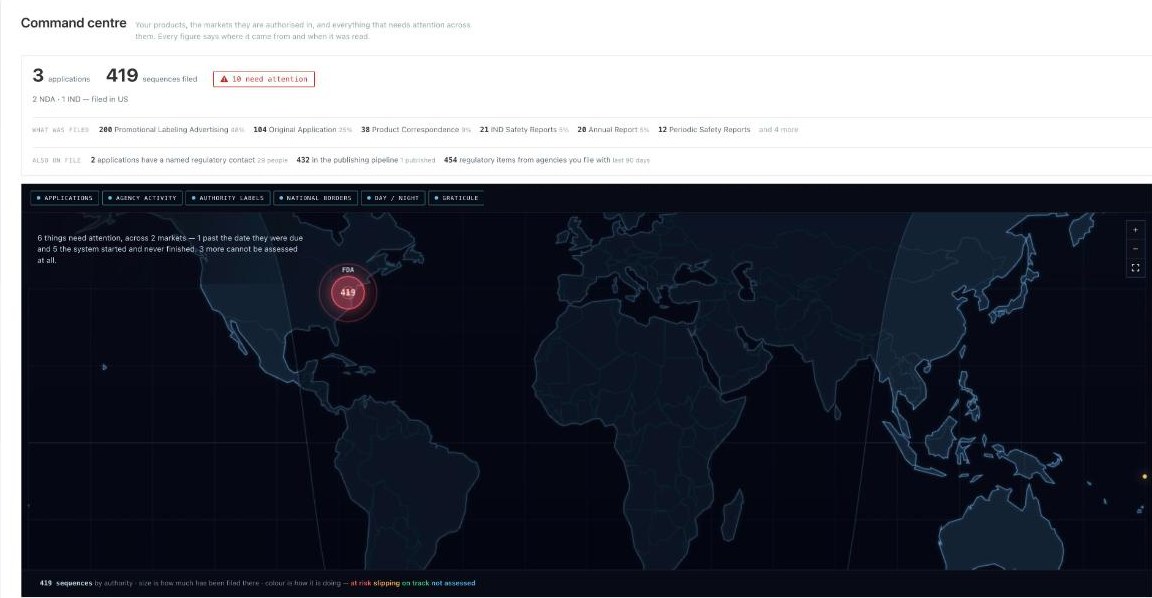
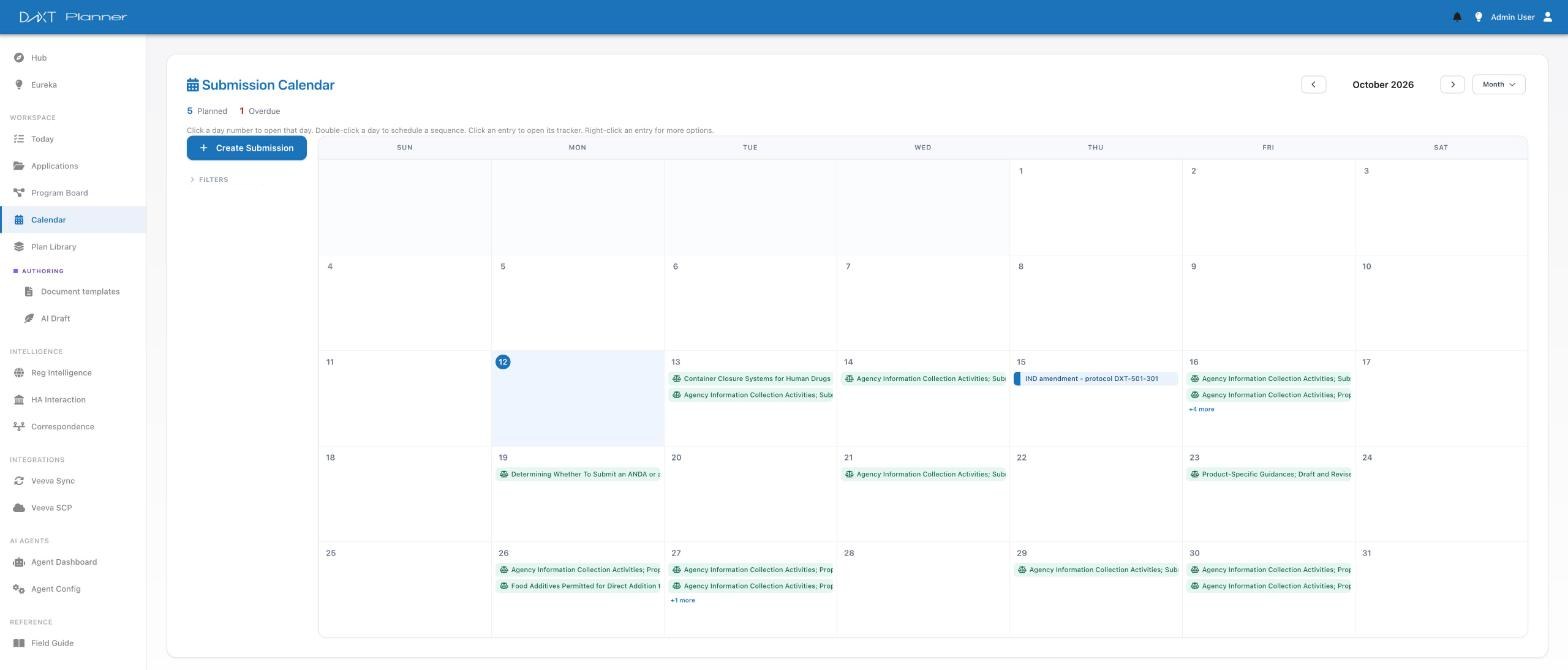
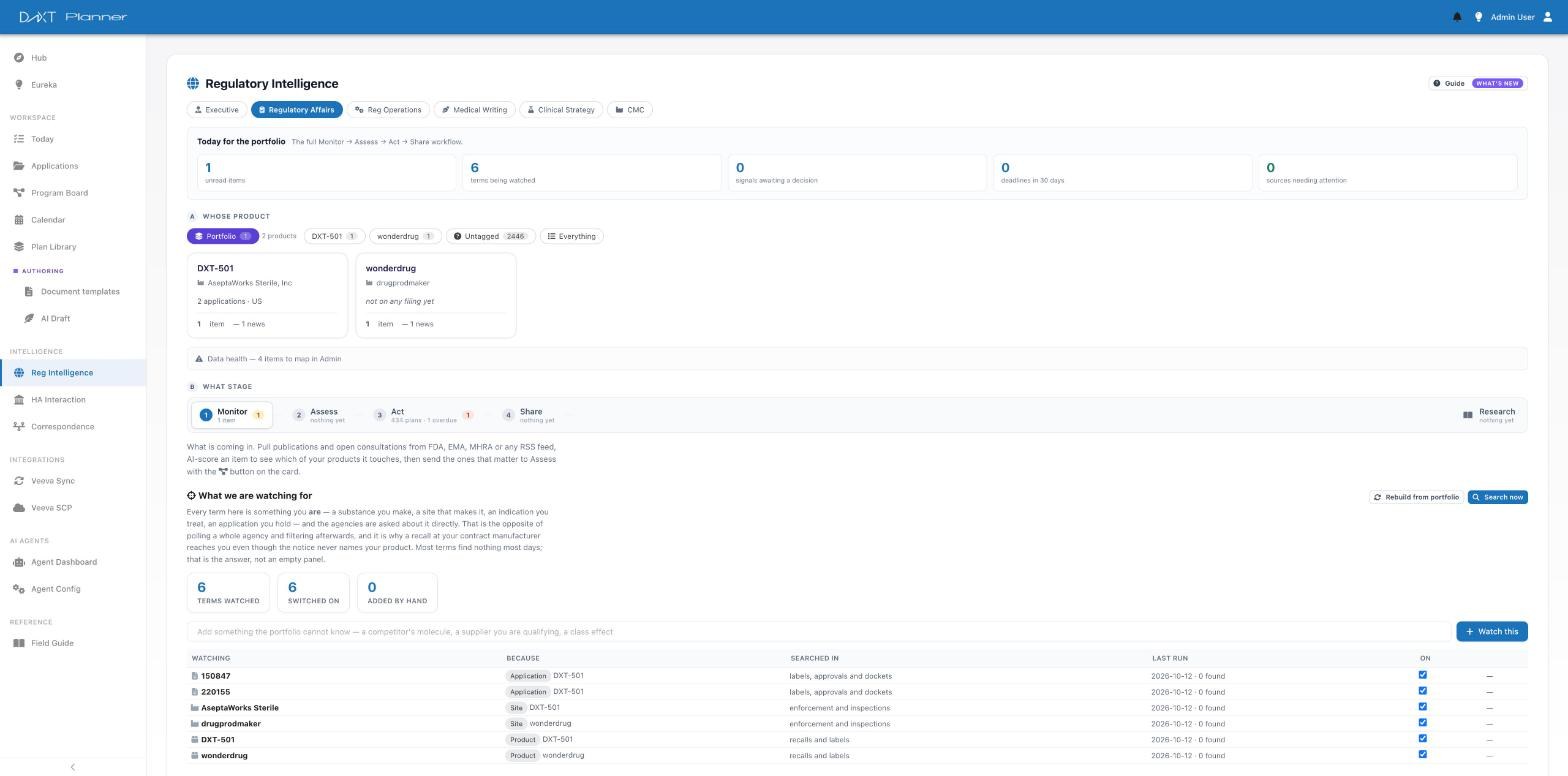
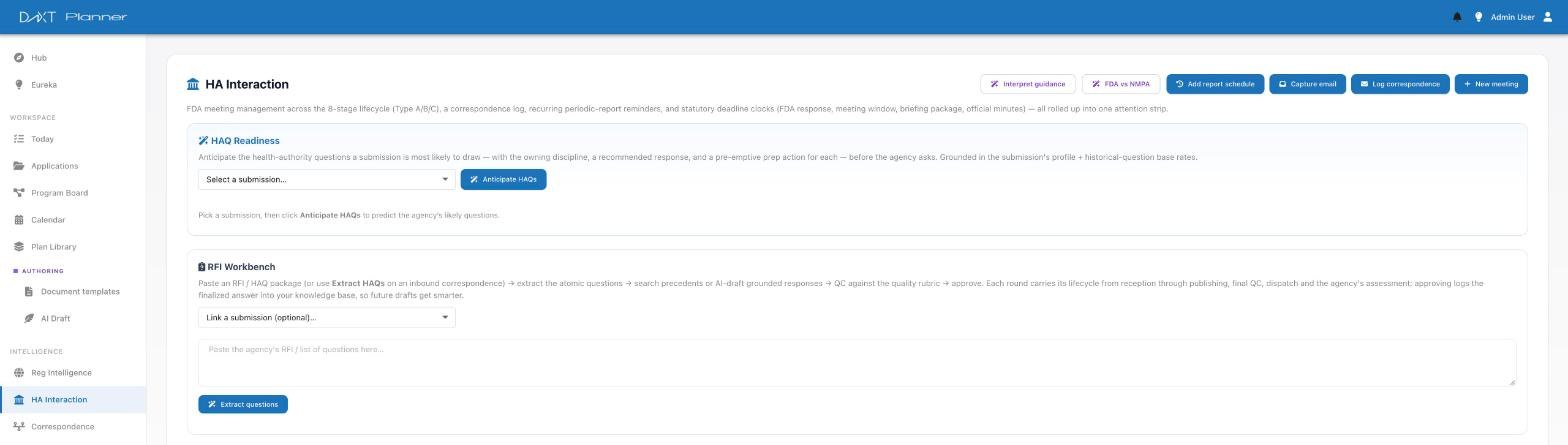
Real screens from DnXT Planner
Captured from our demo workspace. Every name and number on screen is sample data.
Who This Is Built For
DnXT Planner was designed around the three roles who live inside submission trackers today — and lose hours every week reconciling them.
Every program runs its own tracker, every tracker has its own column conventions, and none of them agree with the publishing system. You spend Mondays reconciling spreadsheets instead of managing risk, and when leadership asks "are we on track for the Q3 filing?" the honest answer requires opening six files. You need one portfolio view that rolls up from real document-level status — not from someone's Friday-afternoon manual update.
- Portfolio roll-up computed from live document lifecycle status
- One Submissions destination with a Plan ⇄ Track lens — no tool-hopping
- Milestone register and Gantt with predecessors, not static snapshots
- Status that agrees with publishing, because planning seeds the actual TOC
You own the tracker. You know its 40 columns by heart, you know which cells lie, and you know that one wrong paste before a leadership review costs you an evening. Authoring phases, review rounds, QC findings, publishing handoffs — all of it lives in your head and your conditional formatting. You need the grid you already understand, minus the fragility, with the eCTD structure built in instead of retyped.
- RACI-style grid with 13 lifecycle fields — authoring, reviews, QC, QA, publishing
- One click generates the 8 standard authoring phases per document
- QC/issue log with severity grading and vendor routing built in
- Section catalog derived from the real eCTD structure — no manual TOC typing
Your global core dossier is solid, but every market wants something different — an extra local section here, a non-applicable core section there. Managing those variances across markets in spreadsheets means the same edit gets made five times, or worse, four times. You need a template model where the global core propagates automatically and every market variance is deliberate, visible, and auditable.
- Submission templates with a global core and per-market variants
- Live propagation: edit the core once, every variant inherits it
- Variance ledger — a section × market matrix of every deliberate difference
- Apply-to-submission seeds each market's TOC with a completeness banner
How It Works
From portfolio setup to a publishing-ready submission plan — here's the workflow end to end.
The Planner is organized around three destinations — Portfolio, Submissions, and Templates — consolidated from what used to be five separate surfaces. You register programs and applications once; every submission you plan after that rolls up automatically, grouped by program or application, with a Plan ⇄ Track lens toggle so the same screen serves both forward planning and status review.
A submission template is an editable list of eCTD sections. Market variants inherit the global core, add local sections, and exclude non-applicable core sections — the effective table of contents for any market resolves live as (core ∪ local) − exclusions. Edit the core and every variant inherits the change immediately; the variance ledger shows a section-by-market matrix of every deliberate deviation.
Applying a template to a submission seeds its table of contents from a section catalog derived from the actual eCTD folder structure used in publishing — ICH backbone merged with regional Module 1 — not a hand-typed list. Recommended sections adapt to the submission type, an include/exclude editor keeps scope deliberate, and a completeness banner (for example, "32/115 sections · 28%") tracks coverage as documents land. AI ranks likely-needed sections, with deterministic rules as the fallback, so planning still works with AI switched off.
Each planned section becomes a tracked document with 13 lifecycle fields — authoring status, first- and second-round reviewers, QC, QA, and publishing state. One click generates the 8 standard authoring phases for a document as hierarchical Gantt tasks with predecessors and percent-complete. The grid was designed from real NDA-programme tracking spreadsheets, so it matches how coordination work actually happens rather than imposing a new methodology.
QC findings and issues are logged against specific documents with dual-graded severity and optional vendor routing — so a finding raised on a study report is visible on that row of the grid, not buried in an email thread. The milestone register keeps filing-critical dates alongside document status, and issue closure can be gated behind a two-component electronic sign-off (password re-authentication, cryptographically hashed, fully audited).
Because the plan is built on the same eCTD section catalog the publishing engine uses, the handoff is structural, not clerical. The planned TOC corresponds to real publishable sections in DnXT Publisher, tracked documents map to leaves, and portfolio status reflects what has actually been placed and published — closing the loop that spreadsheets never close.
Six Planner Capabilities That Replace the Spreadsheet
Each one maps to a job the tracker was doing badly — and does it with structure, audit trails, and a live connection to publishing.
eCTD-Aware TOC Planning
Plan against a section catalog derived from the real eCTD structure — ICH backbone plus regional Module 1 — instead of retyping section numbers into column A. Recommended sections adapt to submission type, an include/exclude editor keeps scope deliberate, and the completeness banner shows exactly how much of the planned dossier exists at any moment. Because the catalog is the same structure publishing uses, a plan is never just an aspiration document: it is the skeleton of the actual submission.
Global Core + Market Variants
Define the global core dossier once, then express each market as a variant: inherited core, added local sections, excluded non-applicable sections. Core edits propagate live to every variant, and the variance ledger renders the full section × market matrix so nothing diverges silently. For teams filing one drug in many markets, this replaces the five-copies-of-the-same-spreadsheet pattern with a single, auditable composition model.
Document Tracking Grid
A RACI-style operations grid with 13 lifecycle fields per document — authoring status, review rounds with named reviewers, QC, QA, and publishing state. It was designed from real NDA-programme trackers, so coordinators recognize it instantly; the difference is that status is structured data feeding portfolio roll-ups and timelines, not free text in a cell that only its author can interpret.
Hierarchical Gantt & Milestones
Generate the 8 standard authoring phases per document in one click, then manage them as hierarchical Gantt tasks with predecessors and percent-complete. The milestone register keeps filing-critical dates in the same workspace as document status, so the timeline reflects operational reality rather than a project plan maintained in a separate tool that nobody updates after week three.
QC & Issue Log
Findings are logged against specific documents with dual-graded severity, vendor routing for outsourced work, and a closure workflow that can require a two-component electronic sign-off. The issue log lives on the same grid as the documents it concerns — a blocked study report shows as blocked in the plan, in the timeline, and in the portfolio roll-up simultaneously.
Plan ⇄ Track, One Destination
The Planner consolidated five separate surfaces into three destinations — Portfolio, Submissions, and Templates — with a Plan ⇄ Track lens toggle on the Submissions view. Forward planning and status tracking are two views of the same underlying data, which is precisely what a spreadsheet can never be once the copies start multiplying.
Beyond the Plan: Sequencing, Gates, Risk and Message Control
A plan tells you what goes in the dossier. Getting it filed on time is a different problem — sequencing work against data availability, refusing to let unverified content through, and knowing which risks are still live. These capabilities were built from a study of industry submission-planning practice.
Waves & Bundles
Real submissions are not authored in one pass. A wave groups the content that becomes available at the same time — gated on the data that unlocks it — and a bundle is the unit a review workflow actually opens against. Planning in waves is what lets a team start reviewing Module 2 summaries while Module 5 datasets are still landing, without pretending the whole dossier is ready.
A Review Pipeline With Gates That Fail Closed
A twelve-state review pipeline with documented back-edges, and three enforced content-verification gates: verification must be complete before content approval, the verifier cannot be the author, and the verified version must be a draft minor version rather than an already-approved one. When no author can be identified, the verifier-independence check fails closed rather than waving the document through — the failure mode that matters in a regulated review.
CTD Reference Library
197 CTD-section-to-source-document entries and 88 catalogued document types, each tagged with the programme stage that makes it available — IND, proof of concept, pivotal, process validation. That mapping is what turns "we need Section 3.2.P.5" into "we need these source documents, and they exist only after PPQ" — which is the conversation that actually sets the filing date.
Risk Assessment That Doesn't Flatter Itself
Submission risks are scored probability × impact on a 1–9 scale, and the post-mitigation score is recorded as a separate human judgement — never a recalculation the system performs on your behalf. Risks with no mitigation keep their gross score in the residual total, so the residual figure cannot quietly improve just because someone wrote a mitigation plan nobody executed.
Key Messages Tied to Evidence
The messages a dossier is built to land are managed as records, and each supporting line cites the specific table, listing or figure that backs it, with a true/false validation state. It closes the most common review argument in submission authoring — whether a claim in the summary is actually supported by the data behind it — by making the citation part of the message rather than a comment in a review round.
Backward Timeline From the Filing Date
Give the system a target filing date and it proposes the schedule backwards, using publishing turnaround scaled to dossier size and the minimum durations each pipeline stage genuinely needs. It produces a timeline you can argue with on the merits — rather than one built by dragging bars until the chart fits the date somebody already promised.
Planning Mechanics Worth Knowing
- Section × market matrix — every market's deviation from the global core is visible in one view
- Deliberate exclusions — a core section removed for a market is recorded as a decision, not a deletion
- Live core propagation — core edits flow to variants immediately; variances persist
- Audit-friendly — the ledger answers "why is Module 1.x different in this market?" instantly
- Live banner — planned vs present sections (e.g. 32/115 · 28%) computed, never typed
- Portfolio roll-up — program and application views aggregate from document status
- Plan ⇄ Track lens — the same data serves planning and status review
- No Friday updates — status comes from the lifecycle grid, not manual refreshes
- Section ranking — AI suggests likely-needed sections per submission type
- Rules fallback — deterministic recommendations when AI is disabled or unavailable
- Draft-first boundary — AI output never changes plan state without human confirmation
- Explainable — every recommendation carries a human-readable reason
- Two-component e-signature — password re-authentication with SHA-256 signature hashing
- Gated closure — issue and milestone closure can require signed approval
- Full audit trail — who changed which field, when, on every tracked document
- Part 11-minded — consistent with the platform-wide audit architecture
Retire the Tracker. Keep the Control.
See how DnXT Planner turns 14 spreadsheets into one eCTD-aware workspace — planning, tracking, and publishing on the same platform.